Overview
Legality, special rules, and flavor text
Rules
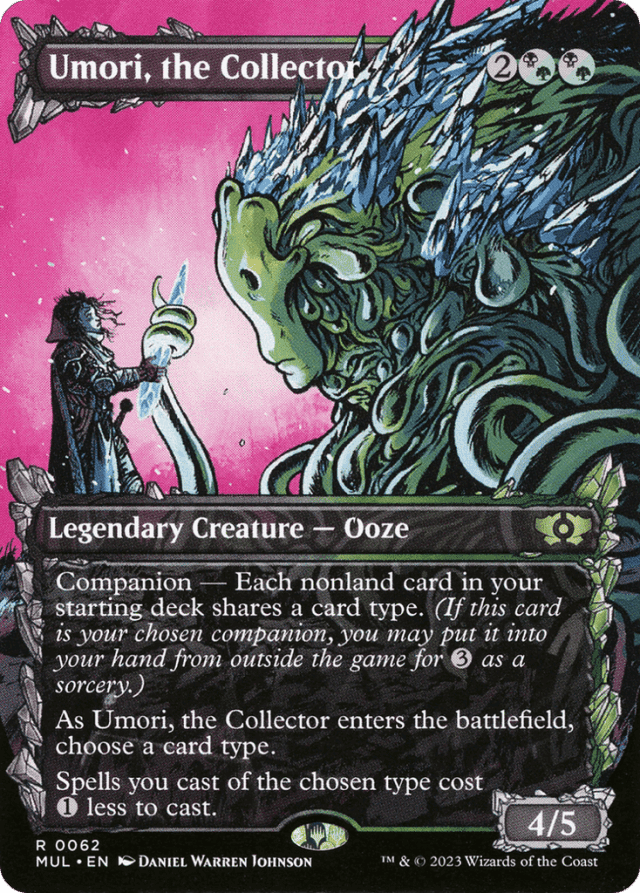
Companion — Each nonland card in your starting deck shares a card type. (If this card is your chosen companion, you may put it into your hand from outside the game for {3} as a sorcery.) As Umori enters, choose a card type. Spells you cast of the chosen type cost {1} less to cast.
Rulings
Artifact, creature, enchantment, instant, planeswalker, and sorcery are card types. Supertypes (such as legendary) and subtypes (such as Ooze) are not. — Before shuffling your deck to become your library, you may reveal one card from outside the game to be your companion if your starting deck meets the requirements of the companion ability. You can't reveal more than one. It remains revealed outside the game as the game begins. — Effects that reduce the generic mana cost of a spell (such as that of Umori) can't reduce that spell's colored mana requirements. — If more than one player wishes to reveal a companion, the starting player does so first, and players proceed in turn order. Once a player has chosen not to reveal a companion, that player can't change their mind. — If you reveal a companion outside the game, for as long as it remains there, you may pay {3} any time you could cast a sorcery (that is, you have priority during your main phase and the stack is empty). Once you do, you put it into your hand and behaves like any other card you've brought into the game. For example, if it's discard, countered, or destroyed, it's put into your graveyard, remaining in the game. This is a change from previous rules. — Land cards in your deck may have any number of additional types that may be shared with other cards or not. — Paying {3} to put your companion into your hand is a special action. It doesn't use the stack and players can't respond to it. Once you take this action, you may cast that card if it's legal to do so before any other player can take actions. — The companion ability has no effect if the card is in your starting deck and creates no restriction on putting a card with a companion ability into your starting deck. For example, Zirda may be in your starting deck even if your other permanent cards don't all have activated abilities. — The companion's other abilities apply only if the creature is on the battlefield. They have no effect while the companion is outside the game. — The requirements of the companion ability apply only to your starting deck. They do not apply to your sideboard. — To satisfy Umori's companion requirement, there must be one card type that each nonland card in your starting deck has. For example, if every nonland card is an artifact creature, enchantment creature, or creature, it is satisfied; but if you have an artifact creature, an artifact, and a creature, it is not satisfied. — You may have one companion in the Commander variant. Your deck, including your commander, must meet its companion requirement. Your companion is not one of your one hundred cards. — Your companion begins the game outside the game. In tournament play, this means your sideboard. In casual play, it's simply a card you own that's not in your starting deck. — If you reveal a companion outside the game, for as long as it remains there, you may pay {3} any time you could cast a sorcery (that is, you have priority during your main phase and the stack is empty). Once you do, you put it into your hand and behaves like any other card you've brought into the game. For example, if it's discarded, countered, or destroyed, it's put into your graveyard, remaining in the game. This is a change from previous rules. — Once you put your companion into your hand, it behaves like any other card you’ve brought into the game. For example, if it’s countered or destroyed, it’s put into your graveyard, remaining in the game. — Paying {3} to put your companion into your hand is a special action. It doesn't use the stack and players can't respond to it. Once you take this action, you may cast that card if it's legal to do so before any other player can take actions. — Wizards of the Coast has issued functional errata for the Companion mechanic. Instead of casting companions from outside the game: Once per game, any time you could cast a sorcery (during your main phase when the stack is empty), you can pay {3} to put your companion from your sideboard into your hand. This is a special action, not an activated ability. It happens immediately and can’t be responded to. It can’t be countered or stopped by cards like Phyrexian Revoker. For more information please see https://magic.wizards.com/en/articles/archive/news/june-1-2020-banned-and-restricted-announcement
Card details
Printing, type line, and catalog data
Identity & printing
- Card ID
- MUL-62--normal
- Name
- Umori, the Collector
- Number
- 62
- Rarity
- Rare
Set, artist & references
- Artist
- Daniel Warren Johnson
- Language
- English
- Set name
- Multiverse Legends
- Game name
- Magic: The Gathering
Battle
Abilities, attacks, weakness & resistance
Extended catalog fields
Extra Scrydex fields not shown in card details above
Raw payload (remaining)
Other game-specific keys from the API
- Supertypes
- Legendary
eBay market prices
Sold and listed medians — tap a grade for comps
More conditions (eBay)
Add LP / MP / HP / DMG or a slab grade (PSA 8, ACE 9, BGS 9.5, …). Everyone sees the same prices; scheduled refreshes include these variants.
Listed on marketplace
Vendors currently listing this card/product on our marketplace. Click through to view or purchase (purchase flow coming soon).
No marketplace listings for this card right now.
More in this set
Other cards from Multiverse Legends

Zirda, the Dawnwaker (Serialized Foil)#195

Zirda, the Dawnwaker (Foil)#195

Yorion, Sky Nomad (Serialized Foil)#194

Yorion, Sky Nomad (Foil)#194

Yarok, the Desecrated (Serialized Foil)#193

Yarok, the Desecrated (Foil)#193

Umori, the Collector (Serialized Foil)#192

Umori, the Collector (Foil)#192

Teysa Karlov (Serialized Foil)#191

Teysa Karlov (Foil)#191

Taigam, Ojutai Master (Serialized Foil)#190

Taigam, Ojutai Master (Foil)#190
Comments
Share your thoughts on this card — condition, value, pull rates, etc.
to comment.
No comments yet. Be the first to share your thoughts.